We Will Rise Again Far Cry 5 Bpm
Far Cry 5 is the fastest-selling title in the popular franchise'south history, and in this exclusive interview, honour-winning audio director Tony Gronick takes yous backside the scenes on the rich sound for the game:
Written by Jennifer Walden. Images courtesy of Ubisoft.
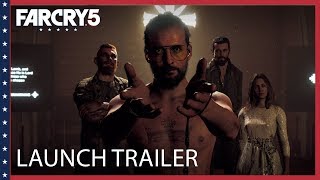
Ubisoft'due south Far Cry v (released March 28th for Xbox One, PS4, and PC) is set in a minor town in Montana where a group of cultist has taken over. The actor, acting as a Deputy, is part of a task force sent to apprehend the cult'due south leader, Joseph Seed. With aid from the residents who have resisted the Seed cult, the player can overthrow the cult'due south outposts and restore order to the boondocks.
Far Cry 5'south award-winning audio director Tony Gronick at Ubisoft Montreal is no stranger to the franchise. He'due south worked on iv Far Cry titles so far. On Far Cry 4, he won the 2015 BAFTA Games Award for 'All-time Music' (shared with composer Cliff Martinez and supervising music editor Jerome Angelot) and earned nominations for best sound at the 2015 MPSE Awards and the 2015 SXSW Gaming Awards. This time around, Gronick was able to be even more involved in the game sound procedure by coming on-board Far Cry 5 much before than he's done on previous titles. Here, Gronick talks about how he used that time to assistance shape the game through sound, particularly in terms of the game's score.

The Far Cry 5 Audio Team (left to right): AJ Abbyad, Phil Hunter, Xavier Gauthier, Tchae Measroch, Cam Jarvis, Chris Ove, Tony Gronick, Mathieu Dirrenberger, Martin Laplante, JS St Pierre, Keling Da, Valentin Garret
This is your fourth Far Cry title, correct? What were you excited about this time effectually? Was there a sonic attribute of the game that you couldn't look to get to piece of work on?
Tony Gronick (TG): Yep, I've worked on Far Weep 3, Far Cry 3: Claret Dragon, Far Weep 4, and now Far Cry 5.
The two things that excited me about Far Cry five is that showtime, I got a chance to exist office of the cadre team at conception. With other Far Cry games the sound team started just prior to production and needed to design the audio around the existing game blueprint. Being part of the team at such an early stage immune associate audio managing director Chris Ove and myself to experiment with systems and designs without the pressure of looming milestones. We too used this time to switch to Audiokinetic'southward Wwise equally our new audio tool.
Secondly, I knew this location. I spent fourth dimension in Montana and neighboring states. I knew the people and the places and I knew the atmosphere.
In Far Cry v, there's said to be a renewed emphasis on melee combat. How did yous apply audio to aid the gainsay feel close-quarters?
TG: Early in product, we decided to put an emphasis on Foley. Nosotros brought experienced Foley creative person Tchae Measroch onto the project and taught him how to implement his own sounds. This worked great. He was able to see and hear what sounds worked and what needed a different approach. We had him do all of the weapon handling, both guns and melee weapons. The outcome of his presence increased the overall emphasis on immersion into the game.
For the melee weapons, audio designer Joh-Alexis Gelinas did virtually of the bear on sounds and implementing. Nosotros did two recording sessions to create the sounds. First, we used pumpkins. Nosotros smashed them with baseball bats (aluminum and wood), shovels, hoes, wood sticks, and pipes. These recordings gave us a good resonance of body impacts.
For the second recording session, we used a semi-frozen uncooked turkey. We slashed at the turkey; we stabbed and cut, ripped and tore the turkey carcass. That gave us swell sounds of blood and guts and gore. We had gloves on merely the more feverish our movements became the more turkey chunks flew into the air. A piece hit me in the eye and I ended up getting salmonella nutrient poisoning. In that location were iii of united states of america on that record session and two of us got sick. (To hear how the baseball bat recordings worked in-game, bank check out this gameplay video.)

Are there any other recordings that you lot captured for the game that yous'd like to talk virtually?
TG: When I was immature, my family unit had a cottage in Qu'Appelle Valley in Saskatchewan, which is simply north of Montana. Here some of my favorite childhood memories occurred. And so when I needed to record ambiences for the game I decided to revisit this old stomping ground of mine. I hadn't been back in over 40 years. I took my son with me and we climbed to the top of the valley's hills. Nosotros recorded open fields, captured sounds of grasshoppers and wheat gently blowing in the current of air. Nosotros went down to the lake and recorded the audio of h2o striking the dock and lapping on the beach. At night, we recorded the crickets. All the time I was telling him stories of when I was his historic period growing up in this environs. That day taught me an important lesson — my son doesn't really care.
In previous Far Cry titles the thespian takes on the role of a ready character, just in Far Weep 5 the player can create his or her own graphic symbol. What did that mean for your team in terms of sound?
TG: The challenge that the audio department had with the 'Character Creator' feature is that the player tin can choose a graphic symbol that is male person or female. The dialogue lines that address a character'southward gender needed to be duplicated. For example, we had about 600 gender-specific lines such as, "At that place she is." And, "There he is."
The bigger trouble was recording lines in other languages. … Having the power to play equally either male or female in this game added almost 13,000 lines of extra dialogue.
In English, we could reduce the overall number of lines by using gender-neutral terms, such as "deputy" for the kickoff person character. The bigger problem was recording lines in other languages. Using a term like "deputy" still needed to have a gender assigned to it. Having the ability to play as either male or female in this game added about thirteen,000 lines of extra dialogue.
Offering the option to choose a character'southward gender requires a lot of extra work. This game had over 100 actors, and roughly 86,000 lines of dialogue. When you first going through that, having to be gender specific, the lines can really add upwards quickly.
How many people on your team were helping yous to wrangle all of this dialogue?
TG: In Montreal we had a team of iii dialogue editors. Having someone at the recording sessions, making sure the lines are candy correctly, and making sure those lines are playing in the game correctly was a huge task. On top of that, we hired freelance voice directors. We worked with another studio in Toronto who handled the cine and they had a total-time dialogue person handling that.
One part of the dialogue we did differently was to have Phil Hunter (one of our senior audio team members) embed himself into the AI department and work closely with them to help design the 'bark' tree for our game. This worked great and we were able to get authentic line counts very early on in the production. (A 'bawl' is an NPC call-out that is used to indicate their location to the thespian.)

Far Cry 5 is set in fictitious Hope County, Montana. What does Hope County sound like?
TG: Hope County sounds similar Eye America. We tried to make the ambient and even the dialect as realistic as possible. When it came to the games' barks, we hired writers who spent fourth dimension in Montana. We also hired an accent coach to work with the hundred plus actors on the roughly 68,000 lines of dialogue.
For the ambiences, the game is divided into iii regions. Each region has a different landscape and sound. We have the open field and farmlands. In that location'due south the mountains and woods area. The third region is Faith'south area. This area deals more with mind manipulation through brainwashing and drugs. In addition to the effects, the separation of these regions also happens musically.
One of the things nosotros did for Faith's surface area was to make it feel like the idealistic 50s-America that's portrayed in Goggle box shows like Go out information technology to Beaver and The Andy Griffith Evidence. Nosotros painted this area with music from the 50s and 60s so that when y'all are walking around you'll hear "Teen Angel" or doo-wop bands playing in the wind. It'south just kind of there and still not there. You lot almost take to terminate walking to hear information technology. It gives the area a creepy, eerie feeling.
Popular on A Audio Consequence right now - article continues below:
The game world is said to exist responsive to the player's deportment. So, if a player clears an outpost of cultists, then the civilians will move back in. In terms of sound, how did you approach the game world? How does the sound conform to the role player's deportment against the cult? Yous know where the cult is because of the cult hymns and music.
TG: You know where the cult is because of the cult hymns and music. They are inspired past this music and they have information technology playing everywhere. It plays off the car radios. When they take an area and gear up an outpost, they put upwardly speakers or they bring in a truck with speakers so their music tin can be heard. So when y'all hear the hymns you know that the cult is nonetheless around. As a histrion removes the cult from an area, the music is also removed. In the case of outposts, the cult music is replaced with American music or radio music. You know the cult is gone because there is a lack of cult hymns.
The game also has a "Resistance Meter." The more harm to the cult a histrion does in an area, the more the "Resistance Meter" goes up. As the "Resistance Meter" goes up, the people in that area are more likely to fight with the player confronting the cult. Y'all'll hear a lot more skirmishes happening around you lot that you have no part of. You're just seeing them in the distance and y'all tin run upward and help if you desire.
I experimented with having the ambience sound darker or non hearing birds merely it didn't seem right. This is a beautiful area. The cult is trying to reap and pillage the land. They take just started doing it and then they haven't had much effect on the land yet. So I kept the ambiences beautiful and rich, and on top of that I added beautiful sounding cult music. Simply there'southward a darkness to the cult music equally well.

Permit's talk about that cult music. The game's score features 'hymn-like gospel music' with lyrics that reinforce the teaching of the Seed cult. How did you develop this feature of the score with composer Dan Romer? Tin you talk about your direction and collaboration on the score?
Music changed the entire outlook of the game. … information technology made the cult'south actions experience like they did these things because they knew better than everyone else; they were saving the lost souls.
TG: I started piece of work on this game at a very early stage. Before Dan Romer joined as the composer, I was trying to experiment a piffling with music. Equally I was watching and playing the game in the early stages, information technology didn't make any sense to me that these religious cultists were taking and killing livestock and burning downward houses, kidnapping and committing murder. It felt a fiddling strange to me, having a religion acting this violent. However when I started experimenting with music, I found that putting traditional hymns upwards against these deportment changed the way that I looked at it. The traditional hymns made it feel like these people were doing the actions of "The Father" (as the leader of the Seed cult is called). Music changed the entire outlook of the game. Instead of information technology feeling like these people were murders and thieves, it made the cult's actions experience similar they did these things because they knew better than everyone else; they were saving the lost souls.
I didn't want this to feel like it was a Christian cult. I wanted to avoid traditional Christian hymns. So I decided that we needed to have our own music for this cult and nosotros went searching for a composer that could besides write songs.
I had been searching for a composer for months and one day I was watching Netflix and I saw this movie Beasts of the Southern Wild. The music was and then beautiful and inspirational, but it didn't sound similar a Far Cry soundtrack, which usually has a darker more electronic feel. Then Chris Ove came to me a week later and said he saw Beasts of No Nation and the soundtrack for that pic had sounded like a Far Cry soundtrack. I listened to that and lo and behold information technology was the aforementioned composer for both — composer Dan Romer.
We took two pieces of music, one from each film, that were in the aforementioned key and combined them. Every bit shortly as I heard that, I knew that this was what I was looking for. Information technology was inspirational but had a darkness at the same fourth dimension.
I looked into Dan Romer and saw that he was as well a producer and a songwriter, and that he had played in bluegrass/land bands in higher. He just ticked off every box we were looking for. We contacted him and he came up to Montreal. He loved the project and he loved the idea of the hymns. This was going to be his first video game and I'1000 not sure he understood how much piece of work he was getting himself into.
Dan Romer met with Dan Hay (the creative director on Far Cry 5) during the meeting Dan Romer was given "The Begetter'south" manifesto, which is a collection of the cult'due south teachings. Romer read it and picked and chose different lines to human activity as inspiration for the hymns. We decided that there should exist 10 hymns and Dan Romer returned to California to start writing. Now I would similar to say there was a lot of back and along on these hymns just Dan Romer nailed them all on his start try. He actually out did himself and as the songs rolled in my smile got bigger and bigger.
Many of these hymns have double meanings. If you heard these songs without knowing the cult they have one pregnant, only as you become more familiar with the cult's behavior the songs take on a very different significant. For instance, in that location is a song called "Help Me Religion" The lyrics get, "Help me Faith, help me Faith, shield me from sorrow, from fear of tomorrow. Aid me Faith, assist me Faith, shield me from sadness, from worry and madness, lead me to the identify."

It'southward a beautiful song until yous find out that "Faith" is the name of The Father's sis. Religion uses drugs and mind command to bring people into the cult. Knowing this gives the song a petty more sinister feel to information technology. At present information technology sounds like someone wanting to get his or her set up.
Each region is controlled past a different family unit member of The Begetter. There'south Jacob, John, and Faith. Each one of them has a different interpretation of these hymns. The hymns are the same — same melody and same lyrics, but it'due south performed completely dissimilar. And so in Jacob's expanse, Dan Romer did bluegrass versions of these hymns, using well-known singers.

Then in John'southward expanse nosotros have this beautiful Nashville choir that we recorded.

It'south very inspiring and sounds cute.
In Faith's region, nosotros hired a postal service-rock band called Hammock.
They did their renditions using the Nashville choir but they added guitars and manipulated the reverbs. Information technology has a postal service-rock, psychedelic experience to information technology. These hymns play a large part in selling the sound of each region.
That stealth music will exist in the aforementioned key as the hymn. They'll play on top of each other.
And then on top of those hymns, as a actor gets closer to an outpost they'll hear the sermons done past whoever owns that area. So if it'south Faith's region, you'll hear Faith giving a sermon. That combined with these hymns gives an eerie feel. Information technology makes the outpost experience like there is a lot of action going on. If the player gets even closer to the outpost, than a stealth music track will boot in. That stealth music volition exist in the same primal as the hymn. They'll play on top of each other. I know that sounds confusing but because in that location is so much reverb on the hymns, it actually works really well. If the player engages in action, then an activeness music rail will have over for the stealth music. We dip the hymns a little bit underneath the action music, simply we don't get rid of it completely.
So let's say a player enters an outpost area and Hymn #3 is playing, then the corresponding piece of stealth music and action music will play with that. If the player dies and comes back and tries to accept the same outpost, a completely different hymn will exist playing and so the stealth music and activeness music will correspond to that new hymn. If yous're non a good player (like myself), yous won't be hearing the same piece of music repeatedly. You volition be hearing a different track every time you redo the outpost.
There are 10 hymns, and each regions' hymns sound dissimilar, so that's thirty tracks. On top of that, sprinkled out among the world there are cult members with audio-visual guitars playing the hymns besides. At that place are 40 renditions of these hymns.

What was your biggest challenge in creating the sound of Far Weep 5?
The cult is driven and inspired by the hymns, and the role player is driven past the stealth or action music.
TG: The music was i of the harder things to figure out on this game. Games are becoming more and more than realistic. Sometimes people forget that it is fine art as well. At that place'due south a lot of question about music playing in games in general and information technology got me thinking that we need to have more of a reason to have music in a game. For Far Cry 3 and Far Weep 4, the music covered when a player was sneaking around, when they were in action, or when there's no one effectually. Music was basically telling the first person player what emotions they should exist feeling. Still in Far Cry v, we tackled it a niggling differently. We nevertheless did what the other games exercise but nosotros also take the music telling the role player how the cult (enemy) is feeling. The cult is driven and inspired past the hymns, and the player is driven by the stealth or action music.
What are yous well-nigh proud of in terms of audio on Far Cry five?
TG: Ane of the things that I did in this game that I call up really anchors the world is the cultists sing along with the hymns. In games, when a player is sneaking up on an NPC, you hear a bark, a line like, "I hope my shift is over pretty presently." Or, "I wonder what time it is?" These let the player know the location of the NPC or enemy. For Far Weep v, I tried to reduce the amount of these lines by having the NPCs sing to the chorus of the hymns playing off the loud speakers. By doing this nosotros are giving the feeling that the cult members are beingness inspired by this music and that they aren't at that place begrudgingly; they're doing The Male parent's work. It worked then well in places and I hope to push it further in upcoming games.
A big thanks to Tony Gronick for giving u.s. a look at the creative vision behind the audio of Far Cry five – and to Jennifer Walden for the interview!
Please share this:
Source: https://www.asoundeffect.com/far-cry-5-sound/
0 Response to "We Will Rise Again Far Cry 5 Bpm"
Post a Comment